
Destination
Indonesia
Seventeen thousand islands, and Bali is barely the first page.
Indonesia does not behave like a country so much as a continent that happens to share a flag. Seventeen thousand islands, six official religions, several hundred living languages, and a time difference between its eastern and western edges that is wider than the gap between London and Moscow. Most trips here begin in Bali — and that is a perfectly good idea — but Bali is roughly the size of a rounding error on the map.
The scale problem nobody warns you about
Look at Indonesia stretched across a globe rather than squashed into a rectangle and the shape of a trip changes. Banda Aceh to Jayapura is a longer flight than Paris to Dubai. Java alone carries more people than Russia. This is the practical fact that undoes most itineraries: distances that look like a lazy afternoon on a map are, in reality, a ferry, a night, and a domestic flight with a dawn departure.
The fix is not to move faster. It is to pick a lane. Java and its volcanoes. Bali and Lombok. Flores and the boats east of it. Sumatra on its own terms. Trying to string all four into two weeks produces a holiday spent mostly in transit lounges, which is a shame in a country this good at standing still.
Bali is an entry point, not a summary
Bali earns its reputation and then gets punished for it. The south is busy in a way that surprises people who came for rice terraces, and the internet has done a thorough job of photographing the same six locations. Go thirty minutes in almost any direction and the island gets quiet again — the east coast around Amed, the northern crater lakes, the temple ceremonies that happen on their own calendar and not for anyone's benefit.
What Bali really offers a first-time visitor is a soft landing: easy transport, good food at every price, and a population accustomed to visitors who have not learned the rules yet. Use it as a runway. Then get on a boat.
Java, where the country actually lives
Java is the engine. Jakarta is enormous, humid, under permanent construction, and far more interesting than its reputation — a city of coffee shops, gallery basements, and traffic that turns thirty minutes into two hours without apology. Yogyakarta is the counterweight: a university city, a court culture, batik workshops, and the two great temple complexes of Borobudur and Prambanan close enough to reach before breakfast.
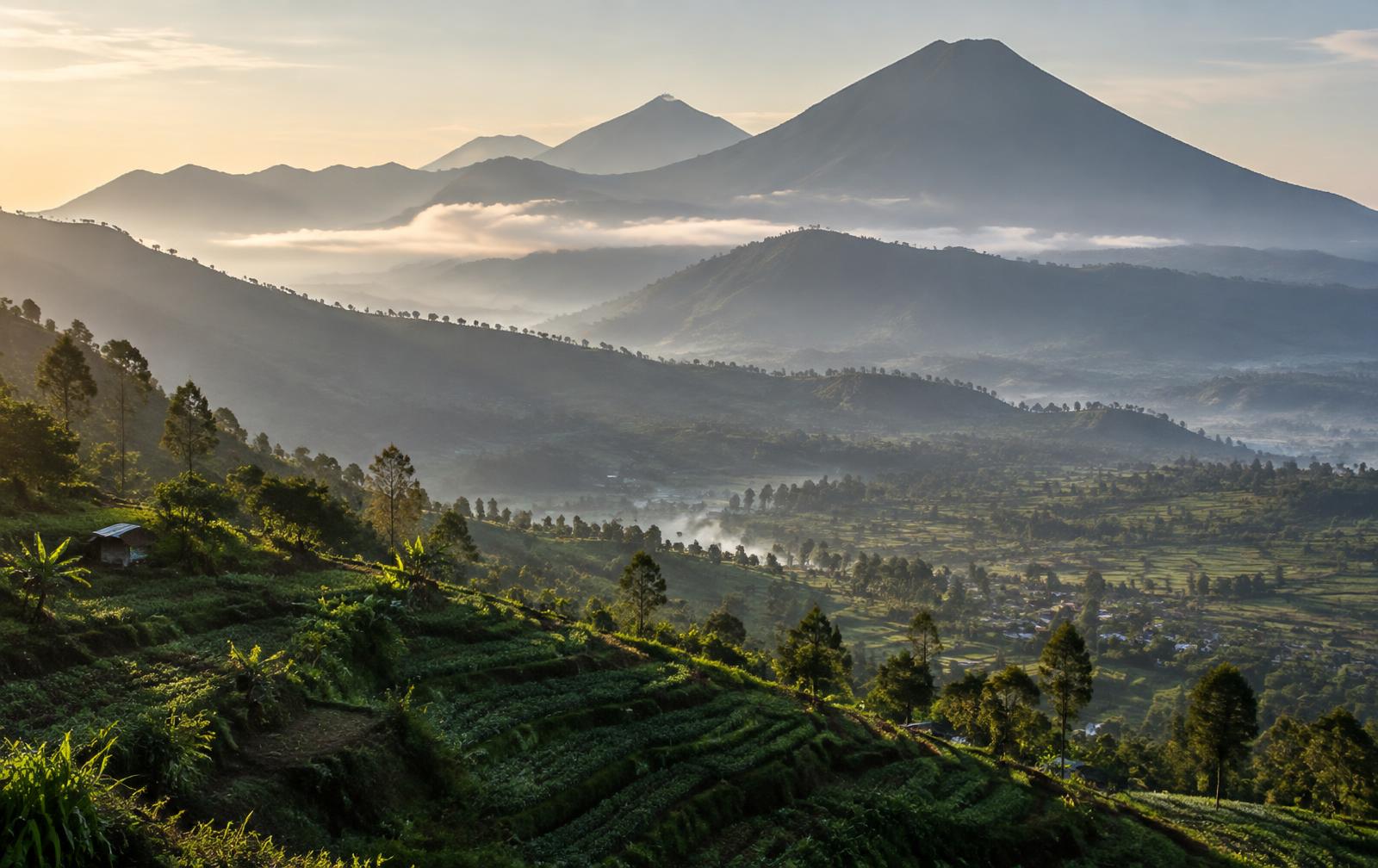
Between them sits the volcanic spine — Bromo, Ijen, the ridge country where the pre-dawn cold is a genuine shock after a week at sea level. Bring a jacket. Nobody ever brings a jacket.
East, into the good stuff
Lombok is the island people describe as "Bali twenty years ago", which is lazy but not entirely wrong: fewer visitors, bigger mountains, and Rinjani looming over everything. Keep going and the Nusa Tenggara chain opens up — Flores, the Komodo boats, dive water that ranks with anything in the region, and villages where the arrival of a stranger is still a small event.
Sumatra is the other direction and another country again: Lake Toba, orangutan forest in the north, Minangkabau architecture, coffee that gets exported before locals see it. It takes effort. It rewards it.
Food that changes every few hundred kilometres
There is no single Indonesian cuisine, which is why "Indonesian food" as a category is nearly useless. Padang food from West Sumatra arrives as a table full of small dishes and you pay for what you touch. Javanese cooking leans sweet. Manado in North Sulawesi is properly, unapologetically hot. Bali runs pork-heavy in a Muslim-majority country because it is Hindu, and babi guling exists as a direct consequence.
The constants are rice, sambal, and the fact that the best meal of your trip will probably cost less than a coffee at the airport.
Etiquette, briefly and usefully
Right hand for giving and receiving. Shoulders and knees covered at religious sites, and a sarong at Balinese temples, usually available at the gate. Ramadan changes the rhythm of daily life across most of the country but not in Bali or the Christian-majority east. Take shoes off when the shoes outside the door tell you to. Learn terima kasih — it does more work than any other word you will carry.
Weather, and why "the dry season" is a regional claim
Broadly: dry from roughly May to September, wet from November to March. But the archipelago spans the equator in both directions, so the rule bends. The Malukus run almost opposite to Java. Eastern Nusa Tenggara is markedly drier than Sumatra. Check the specific island, not the country, and remember that wet season rarely means all-day rain — it usually means a violent, efficient downpour in the afternoon and a clear evening afterwards.
What makes it feel different from its neighbours
Thailand and Vietnam are countries you can legibly cross. Indonesia is not; it is a set of destinations that happen to share a passport stamp, and travel here is a series of decisions about what to leave out. The religious texture is different too — the call to prayer over most of the country, Hindu ceremony in Bali, churches in Flores, all inside one border.
It is also the least uniform place in the region. The gap between a Jakarta rooftop and a Flores village is not a gap of degree but of kind. That is the appeal, and the reason it is worth returning to instead of ticking off.
currency
Indonesian rupiah (IDR)
language
Indonesian (Bahasa Indonesia)
best_time
May to September (varies by island)
transport
Domestic flights, ferries, ride-hailing
What surprised me
- Domestic flights are cheap and frequent, and they quietly make ambitious routes possible — but baggage rules are strict and enforced. - Cash still matters outside the cities. ATMs on small islands run dry, particularly around public holidays. - Sunday is a genuinely busy travel day; local weekend tourism fills ferries and hill stations. - A sarong in the daypack solves temple access, sun, and an unexpectedly cold bus in one item.