
Malaysia · Kuala Lumpur · Story
Kuala Lumpur at Dusk: A City of Contrasts
Modern skylines, layered neighborhoods, and one of Southeast Asia’s easiest capitals to settle into
28 August 2026
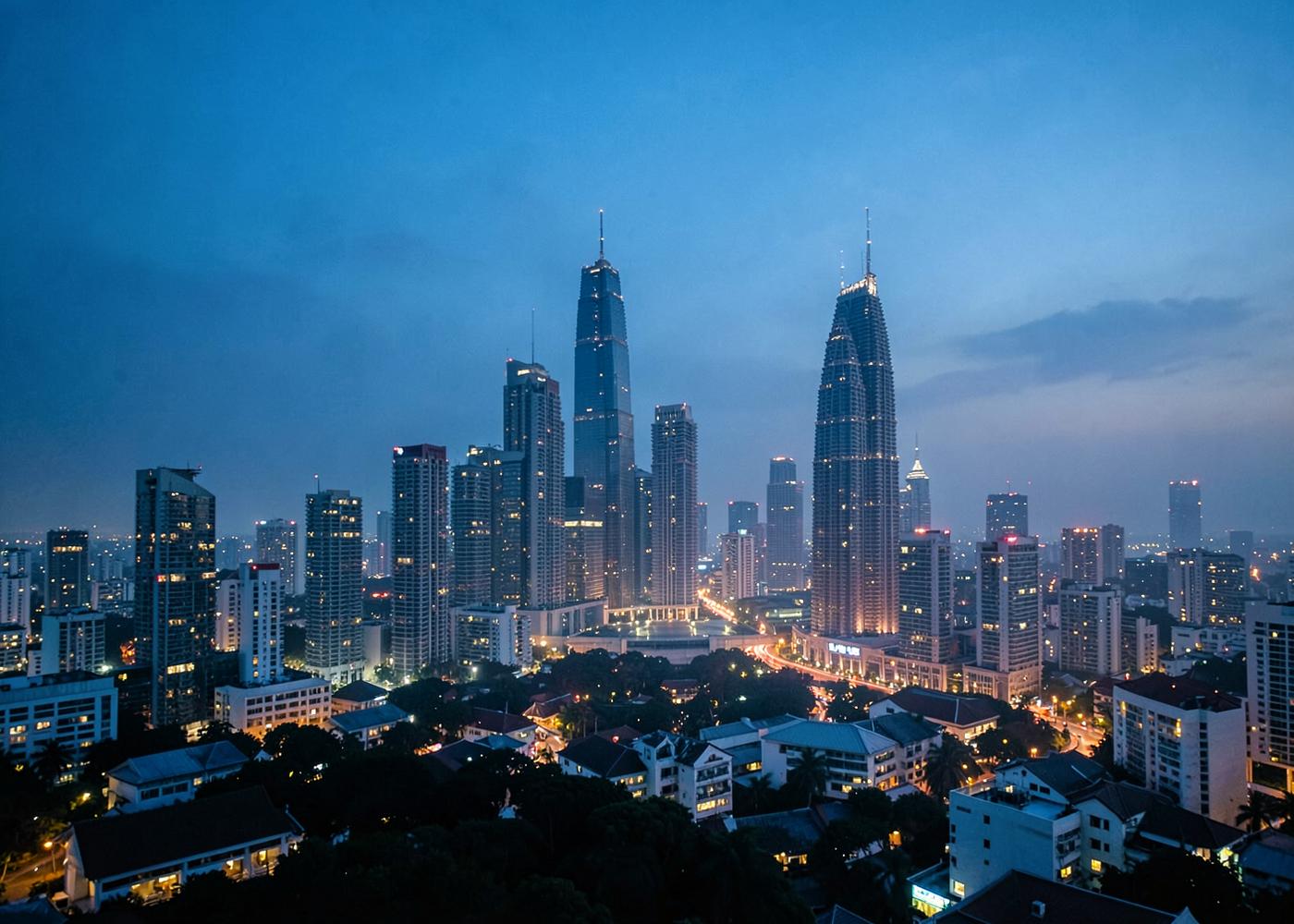
Kuala Lumpur is not trying to seduce anybody, which is a large part of why it works.
It has the skyline — the Petronas Towers do exactly what they are supposed to do to your neck the first time you stand under them — but it is not a city that leads with spectacle. It leads with lunch. It leads with the fact that a city of this size is remarkably easy to be in, and that within a twenty-minute walk you can move through three distinct cultures without anyone treating that as remarkable.
The skyline is the trailer, not the film
Every visitor does the towers, and they should. The scale is genuinely absurd at close range, the steel catches light strangely at dusk, and the park behind them is one of the better free things in the city centre.
But KL's skyline is unusual for a different reason: it is surrounded by green in a way most Asian capitals are not. Fly in during daylight and the city appears as clusters of towers pushed up out of rainforest, with the hills still visible behind. That geography shows up at street level too — hot, humid air that carries the smell of vegetation, sudden late-afternoon downpours, and vines working their way up the edges of anything left alone for a season.
Kuala Lumpur is a skyline built on top of a jungle, and the jungle has not entirely conceded the point.
Neighbourhoods that sit right next to each other and share nothing
The central districts change character block to block, and the walk between them is the best introduction to the city.
- **Chinatown / Petaling Street** is loud, covered, and deeply commercial, with old shophouses, herbal shops, and hawker stalls operating out of doorways. The temple at its edge is Hindu. The one four streets away is Chinese. Nobody finds this odd.
- **Little India / Brickfields** smells like cardamom and hot ghee and plays music at a volume that makes conversation optional. Banana-leaf lunch here is one of the best-value meals in Southeast Asia.
- **Kampung Baru** is a Malay village that the city grew around and never absorbed. Low wooden houses, gardens, chickens, with the towers rising directly behind. It is the single strangest and best view in KL.
- **Bukit Bintang** is malls, neon and street food, and is where the city looks most like a generic modern Asian centre — which has its own appeal after a day in the heat.
You can walk between all of them, though "walk" in KL means accepting that pavements occasionally stop for no reason and that you will be sweating within ten minutes.
Food is the actual attraction
Malaysia's food is the reason to come, and Kuala Lumpur is where all of it arrives at once. Malay, Chinese and Indian cooking have been sharing a kitchen here for generations, and the result is not fusion — it is three complete cuisines plus everything that happened where they overlapped.
A short, non-exhaustive list of things worth building a day around:
- **Nasi lemak** for breakfast: coconut rice, sambal, anchovies, egg. The national dish, and correctly so.
- **Banana leaf rice** in Brickfields, where refills are unlimited and stopping is your responsibility.
- **Char kway teow** and **hokkien mee** from a hawker centre, cooked over heat that would be illegal in a domestic kitchen.
- **Roti canai** at basically any hour, from a mamak stall, with dhal and teh tarik.
- **Durian**, if you are feeling brave. The smell is not an exaggeration. Neither is the texture.
Mamak stalls — the Indian-Muslim open-air eateries that run most of the night — are the city's real social infrastructure. Cheap, open late, and full of a genuine cross-section of the city at two in the morning.
The practical stuff that makes it easy
KL is one of the least frictional cities in the region for a visitor:
- English is widely spoken. Signage is bilingual. Almost nothing requires a translation app.
- The rail network — LRT, MRT, monorail — covers most of what a visitor wants, is cheap, and is air-conditioned, which matters more than it sounds.
- Ride-hailing is cheap and universal. Taxis are best avoided.
- The airport train gets you into the centre in about half an hour.
- The ringgit goes a long way. Good food is inexpensive and decent accommodation is markedly cheaper than Singapore or Bangkok.
- Heat and humidity are the real constraint. Plan around midday rather than through it.
The one genuine annoyance: KL is a driving city with walking ambitions. Pedestrian routes are improving but still get interrupted by highways and construction. The rail network plus short ride-hail hops solves it.
Where the city gets quiet
Dusk is the best hour. The light goes copper across glass, the call to prayer carries over traffic, the towers switch on, and the temperature finally drops below oppressive.
The quiet parts are easy to find if you leave the centre. Kampung Baru at dusk is almost rural. The lake gardens are properly green and largely empty on weekday evenings. The Batu Caves, half an hour north, are chaotic at the base and strangely still at the top of the steps, once the crowd thins and the macaques lose interest in you.
Who KL is for
If you want a city that announces itself, Bangkok or Ho Chi Minh City will do that harder. Kuala Lumpur is a slower read. It is for people who like walking through neighbourhoods, eating several times a day, and having a capital city be easy rather than dramatic.
It is also the best possible first stop in Southeast Asia. Everything works, everything is legible, the food is extraordinary, and it gives you a few days to adjust to the heat before the region turns the difficulty up.
Three days is enough for a first look. It is also, reliably, the point at which people start checking how much longer they could stay.
Three days, sensibly arranged
**Day one:** Chinatown and the shophouses in the morning, banana leaf lunch in Brickfields, the towers and the park at dusk, hawker dinner at street level.
**Day two:** Kampung Baru early while it is cool, the Islamic Arts Museum through the worst of the heat, then the lake gardens as it drops, and a mamak stall late.
**Day three:** Batu Caves first thing before the crowds and the heat, then whichever neighbourhood from day one you wanted more time in. That is usually the right instinct.
Small things that make a difference
Carry an umbrella from about March onward — the afternoon rain is short and absolute. Keep a light layer for shopping malls and trains, which are cooled to a temperature unrelated to the weather outside. Pay for transport with a stored-value card rather than queueing for tickets. And eat before nine at night, when a lot of the better hawker stalls start winding down.
Kuala Lumpur is a city that quietly rewards a low-effort approach. Walk a neighbourhood, eat, sit somewhere cool, repeat. That is a genuinely excellent three days.