
Thailand · Bangkok · Story
Bangkok After Dark: Where the City Really Comes Alive
Street food, late-night energy, and the quieter details that show up after sunset
4 September 2026
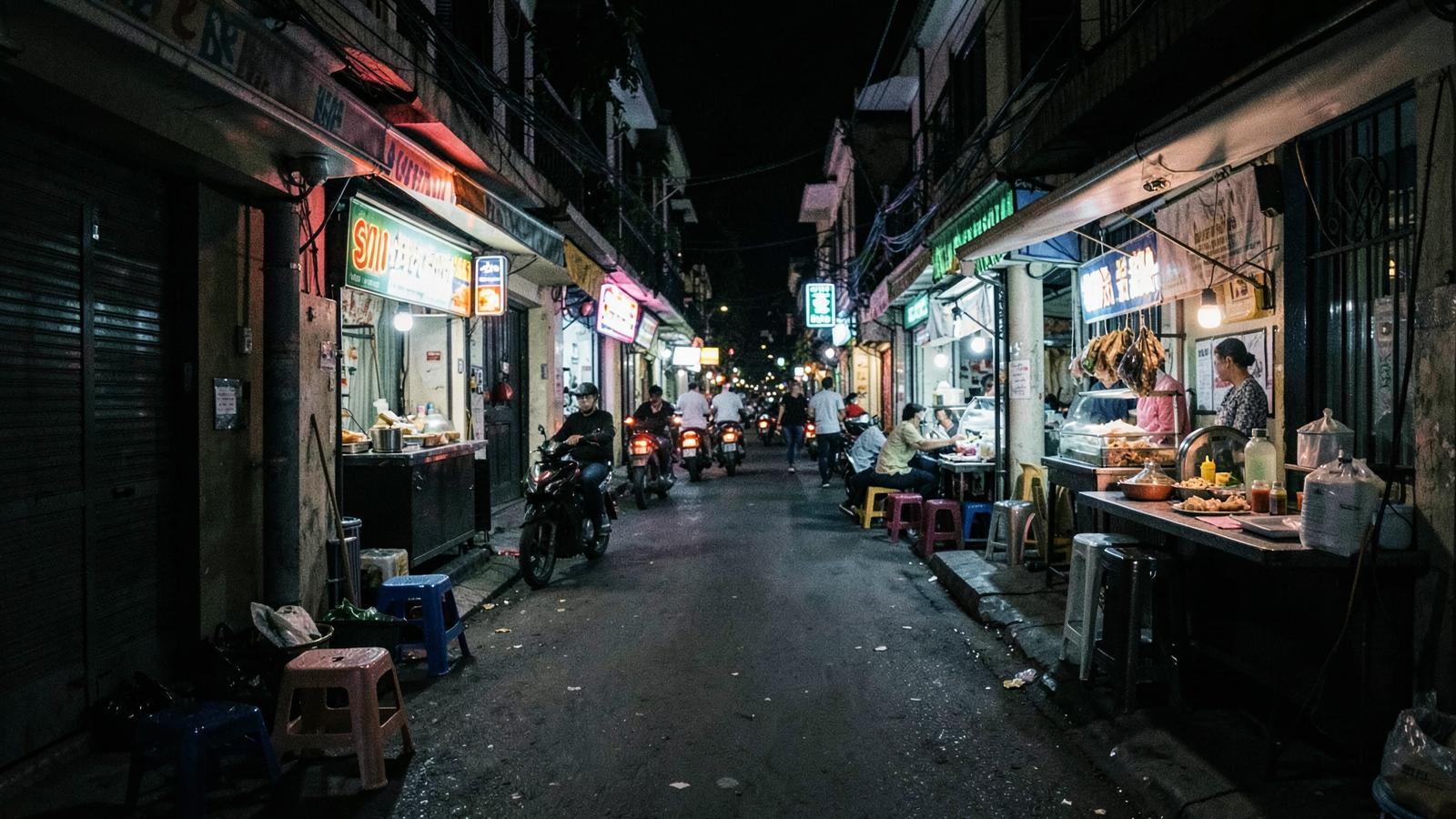
Bangkok does not really end its day. It changes shift. The heat lets go somewhere around six, the light turns from white to amber to that particular violet you only get over a city with this much dust and river in the air, and the streets refill with a completely different crowd than the one that emptied out of the offices an hour earlier.
If you only see Bangkok between nine and five, you have seen the paperwork. The evening is where the personality lives.
The hour when the city exhales
There is a window, roughly between five-thirty and seven, when everything overlaps. Office workers in pressed shirts stand next to grill carts. Schoolkids buy iced milk tea in bags. The Skytrain platforms fill and empty in waves, and below them the sidewalk vendors are unfolding tables, lighting burners, stacking plastic stools that will be occupied within minutes.
It is the most honest hour in the city. Nobody is performing for anybody. The smell alone tells you what is happening: charcoal, garlic hitting hot oil, grilled pork fat, the sweet-sour hit of som tam being pounded somewhere just out of sight.
Practical note: this is also the worst possible time to be in a taxi. If you have somewhere to be between five and seven, take the BTS or the MRT, or accept that you will spend forty minutes watching a meter tick in Sukhumvit traffic. The boats on the Chao Phraya are the underrated third option — cheap, fast, and the only commute in the city with a view.
Street food is not a scene here, it is dinner
The thing that surprises people is how unremarkable street food is to the people eating it. There is no ceremony. A stool, a bowl, seven minutes, gone. Most of the best carts do one thing and have done that one thing for years, which is exactly why they are good.
A few things worth knowing before you eat your way through an evening:
- Look for the cart with a queue of people who clearly work nearby. Not tourists — locals on their way home. That queue is the entire review system you need.
- Single-dish specialists beat long menus. A cart with a photo menu in four languages is usually optimizing for something other than the food.
- Carry small notes. Nobody wants to break a thousand baht for a forty-baht bowl of noodles.
- Point and smile works fine. So does learning "mai phet" if you would rather not sweat through your shirt — though be aware this is treated as a suggestion rather than a contract.
Yaowarat, the Chinatown stretch, is the obvious one and it genuinely earns the reputation, especially after dark when the whole street becomes a corridor of neon and grill smoke. But some of the better eating happens on unremarkable sois in residential areas, where the crowd is entirely people who live one block away.
The quiet Bangkok that shows up after ten
Here is the part that does not make the highlight reels. Once the dinner rush fades, large stretches of the city go genuinely calm.
Temple walls go dark and the gold stops shouting. The canals — the khlongs — reflect apartment lights and almost nothing moves. Walk a residential soi at eleven at night and you will hear televisions, a dog, somebody washing dishes, and very little else. The contrast with the noise two streets away is startling the first time.
That is the version of Bangkok worth staying up for. Not the party version, though that exists and is easy enough to find. The version where a megacity of eleven million manages, in pockets, to feel like a neighborhood.
The loudest city in the region has more quiet corners than almost anywhere else in it. You just have to be out late enough to find them.
Rooftops: worth it, with conditions
Bangkok's rooftop bars are genuinely spectacular, and they are also priced accordingly. The view is the product, and the view is real — the city from above at night is an enormous grid of light with the dark ribbon of the river cut through it.
Conditions for making it worth the money: go early, around sunset, before the cover charges and the crowds. Check the dress code, because several places will turn you away for shorts and sandals with a politeness that somehow makes it worse. And accept that one drink is a perfectly respectable amount to order. Nobody is keeping score.
If the budget says no, the free alternative is the river. Take a public boat at dusk, sit on the outside deck, and you get the skyline, the temples lit from below, and the warm wind for roughly the price of nothing.
Getting around when everything is open
The BTS and MRT run until around midnight, which catches most of an evening but not all of it. After that it is taxis and ride apps. Two habits make late-night transport painless:
- Use a ride-hailing app rather than negotiating. The fare is fixed, the route is logged, and you skip the entire conversation about whether the meter is working tonight.
- Have your destination written in Thai, or on a map pin. Pronouncing a street name confidently is not the same as pronouncing it correctly.
Motorbike taxis — the drivers in orange vests at the mouth of most sois — are the fastest way to cover a short distance in traffic. They are also a motorbike in Bangkok traffic. Make that decision with a clear head.
What to do with a first evening
If you have one night and want it to count, a workable shape: be somewhere high or on the water for sunset, eat at street level for the next two hours, then walk a residential neighborhood without a destination. That sequence gets you the postcard, the food, and the actual texture of the place, in that order.
Skip anything that promises to show you the "real" Bangkok. The real Bangkok is a man selling grilled squid at eleven at night who is mildly indifferent to whether you buy any.
What stays with you
Bangkok is frequently described as chaotic, which is lazy shorthand for dense. It is extraordinarily organized underneath the noise — vendors setting up in the same square metre every evening, boats hitting the same piers, the same crowd of regulars at the same plastic tables.
The pleasure of the city after dark is watching a system that large run smoothly while looking, at first glance, like it is barely holding together. Stay a few nights and the noise resolves into a rhythm. Then it is just a very big city having dinner outside.
Bangkok rewards second and third visits more than almost anywhere. The first night is sensory overload. The third is when you notice you know which corner has the better noodles.
Three nights, if that is all you have
**Night one:** Yaowarat. Overwhelming on purpose, and the right introduction. **Night two:** the river. A public boat at dusk, dinner on the Thonburi side, and a walk back through a neighbourhood with no bars in it. **Night three:** whichever of those you wish you had spent longer on. That answer is usually the second one.
Small things that make a difference
Carry tissues — most street stalls do not supply napkins. Take a light layer for the Skytrain and malls, which are cooled well past comfortable. Keep an eye on the last train time if you are far from your hotel. And eat the fruit; a bag of cut pineapple at eleven at night is the best forty baht in the city.