
Vietnam · Ho Chi Minh City · Destination guide
Crossing Ho Chi Minh City One Street at a Time
A practical introduction to traffic, walking, coffee stops, and finding your rhythm in Vietnam’s biggest city
6 August 2026
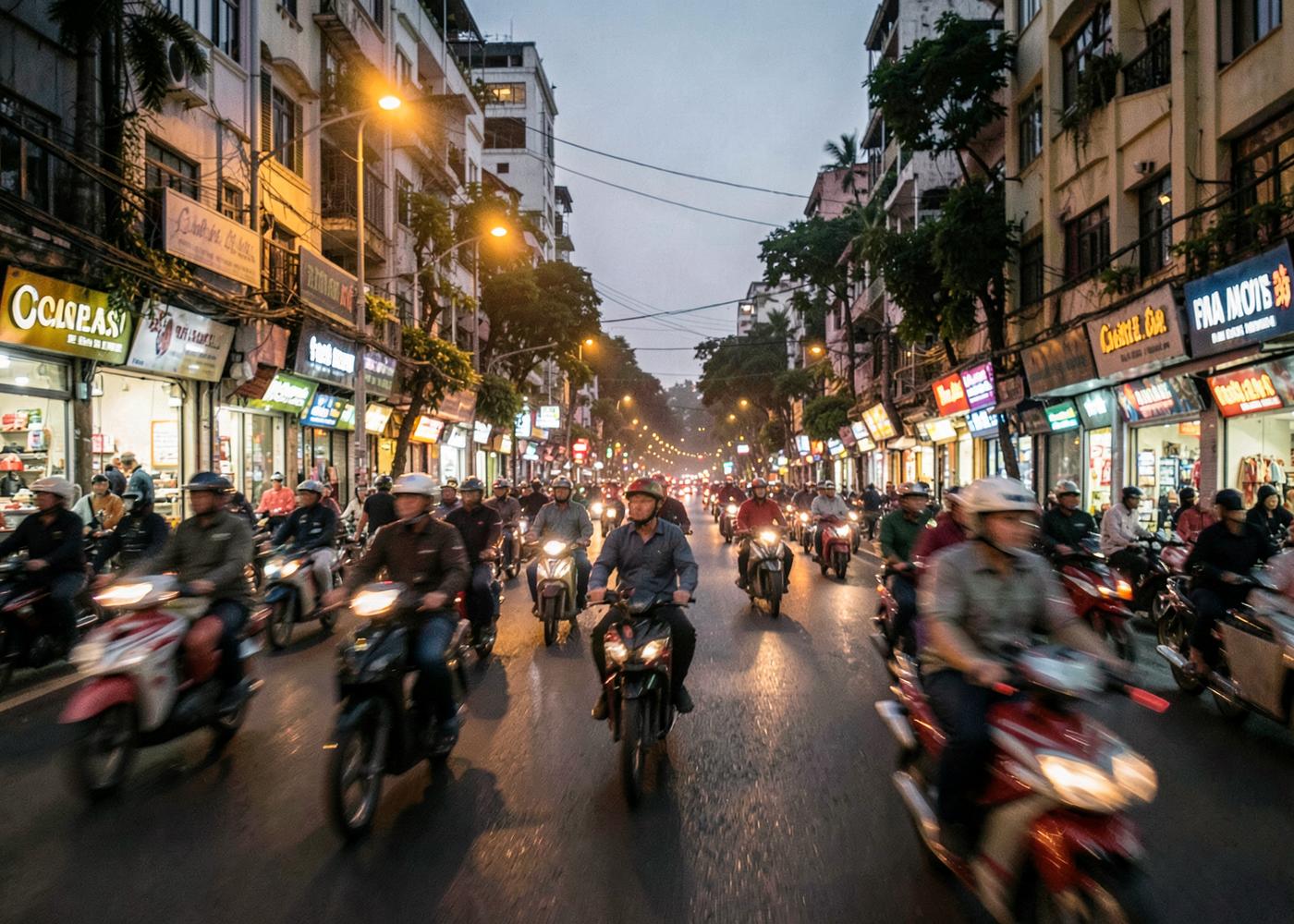
The first attempt at crossing a busy street in Ho Chi Minh City is a genuinely memorable experience, because every instinct you have is wrong.
There is no gap. There will not be a gap. Standing on the kerb waiting for one is how you spend a morning. The technique — and it is a technique, used by everyone here — is to walk out at a steady, predictable pace and let the traffic flow around you. The motorbikes are not going to stop. They are going to adjust. Your only job is to be boring enough to be predictable.
Once you get that, the city opens up. Almost everything else about Ho Chi Minh City follows the same principle: it looks like chaos, it is actually a system, and it works fine as soon as you stop resisting it.
What the traffic is actually doing
Something like eight million motorbikes move through this city. At intersections they behave less like cars and more like water — filling space, merging at angles, flowing around obstructions.
The practical rules that matter:
- **Cross steadily. Never run, never stop mid-road, never reverse.** Sudden changes are the only genuinely dangerous thing you can do.
- **Watch the far lane, not the near one.** The near riders have already accounted for you.
- **Follow a local across the first few times.** Shameless and effective.
- **Pavements are parking.** You will often be walking in the road. Everyone is.
Give it two days and you will be crossing six lanes mid-block while looking at your phone, which is both a milestone and a bad habit.
Coffee is the city's best institution
Vietnamese coffee culture is the single most enjoyable thing about being here. Robusta beans, dark roast, brewed through a small metal phin filter, dripped over condensed milk, poured over ice. It is strong enough to rearrange your afternoon.
Where it gets good is the furniture. Cafés here spill onto the pavement on tiny plastic stools facing the street, because the entertainment is the street. People sit for an hour watching traffic. That is the activity. It is a completely legitimate way to spend a morning and it is how you actually see the city.
Worth trying beyond the standard cà phê sữa đá:
- **Egg coffee**, a Hanoi export, whipped yolk and condensed milk over coffee, closer to dessert than drink.
- **Coconut coffee**, blended with coconut cream, which is more refreshing than it has any right to be.
- **Black, with a little ice and no milk**, if you want to find out what robusta actually tastes like.
The coffee shop districts around the old apartment blocks — particularly the famous café building on Nguyen Hue — are worth a slow afternoon, one floor at a time.
Eat at the stools
The best food here is at knee height. Sidewalk kitchens, one dish, plastic stools, bowls arriving within a minute of sitting down.
- **Phở** in the morning, which is when Vietnamese people actually eat it.
- **Bánh mì** from a cart, the best sandwich argument in the world: French baguette, pâté, pickled vegetables, coriander, chilli.
- **Cơm tấm**, broken rice with grilled pork, a southern staple and the most common working lunch in the city.
- **Bún thịt nướng**, cold noodles, grilled meat, herbs, fish sauce dressing, ideal in heat.
- **Hủ tiếu** at night from a cart pushed through residential streets.
The hygiene question everybody asks: high-turnover stalls are generally fine. Food sitting out in the sun is not. Use the same judgement you would anywhere and you will be fine.
Finding the districts
Ho Chi Minh City is organised into numbered districts, which sounds bureaucratic and is actually useful once it clicks.
- **District 1** is the centre: the old post office, the cathedral, the Reunification Palace, the walking street, most of the hotels.
- **District 3** is quieter, leafier, and where a lot of the better coffee is.
- **District 5** is Cho Lon, the historic Chinese quarter, with temples, herb shops and wholesale markets, and a completely different atmosphere.
- **Thao Dien** in District 2 is the green, expat-heavy riverside area — useful if you want a break from noise.
Walking between districts is possible but hot. Ride-hailing on the back of a motorbike is cheap, fast, and the best way to feel the traffic system from the inside.
The history is not optional
The War Remnants Museum is difficult, one-sided by design, and essential. The Cu Chi tunnels, a couple of hours out, are the other half of the same story and get very busy — go early.
Whatever you think about how the history is presented, spending a morning with it changes how you read the city for the rest of the trip. This is a place that was substantially rebuilt within living memory, and the pace of the last thirty years — the towers, the metro, the construction everywhere — reads differently once you have that context.
A city with an average age this young, moving this fast, is not really looking backwards. But it is worth knowing what it is moving away from.
Practical notes
- **Money:** Vietnamese dong, with a lot of zeros. Check the number of digits before handing anything over — the 20,000 and 500,000 notes look similar in poor light.
- **Ride-hailing** is universal, cheap, and removes all haggling. Use it.
- **Weather:** dry season roughly December to April. Wet season means a hard, short downpour most afternoons, usually done in an hour.
- **Heat:** the humidity is constant. Two showers a day is normal, not indulgent.
- **Noise:** it is loud. Check which side of the building your room is on.
The rhythm, once it makes sense
Around day three, something shifts. You stop noticing the horns. You cross without thinking. You know which corner has the coffee you like and you sit on the stool facing outward like everybody else.
That is the whole experience of Ho Chi Minh City: an intensely busy place that turns out to be extremely easy to be in, provided you stop trying to impose order on it and let the flow do the work.
Then you get on a plane, and somewhere over the next country you realise you miss the noise.
Small things that make a difference
Keep a few 10,000 and 20,000 dong notes accessible for coffee, parking attendants and small purchases — breaking a 500,000 for a 25,000 drink is a minor ordeal for everyone involved. Carry a light rain layer in wet season; the downpour is on a schedule even if nobody publishes it. Ask before photographing vendors, and buy something afterwards, which makes the whole exchange better anyway.
A first-timer's day, roughly
Phở at a pavement stall before eight, while it is still cool enough to enjoy hot soup. Two hours in the War Remnants Museum. Cơm tấm for lunch somewhere with a queue. An air-conditioned hour indoors during the worst of the heat. Coffee on a stool from four. Street food and a walk through District 5 or along Nguyen Hue after dark.
That is one day, and it covers food, history, heat management and the city's two speeds. Do a version of it three times and you will know Ho Chi Minh City better than most itineraries manage in a week.