
Vietnam · Story
Vietnam Is Better When You Stop Fighting the Chaos
Motorbikes, tiny stools, strong coffee, and the moment the city rhythm starts making sense
16 September 2026
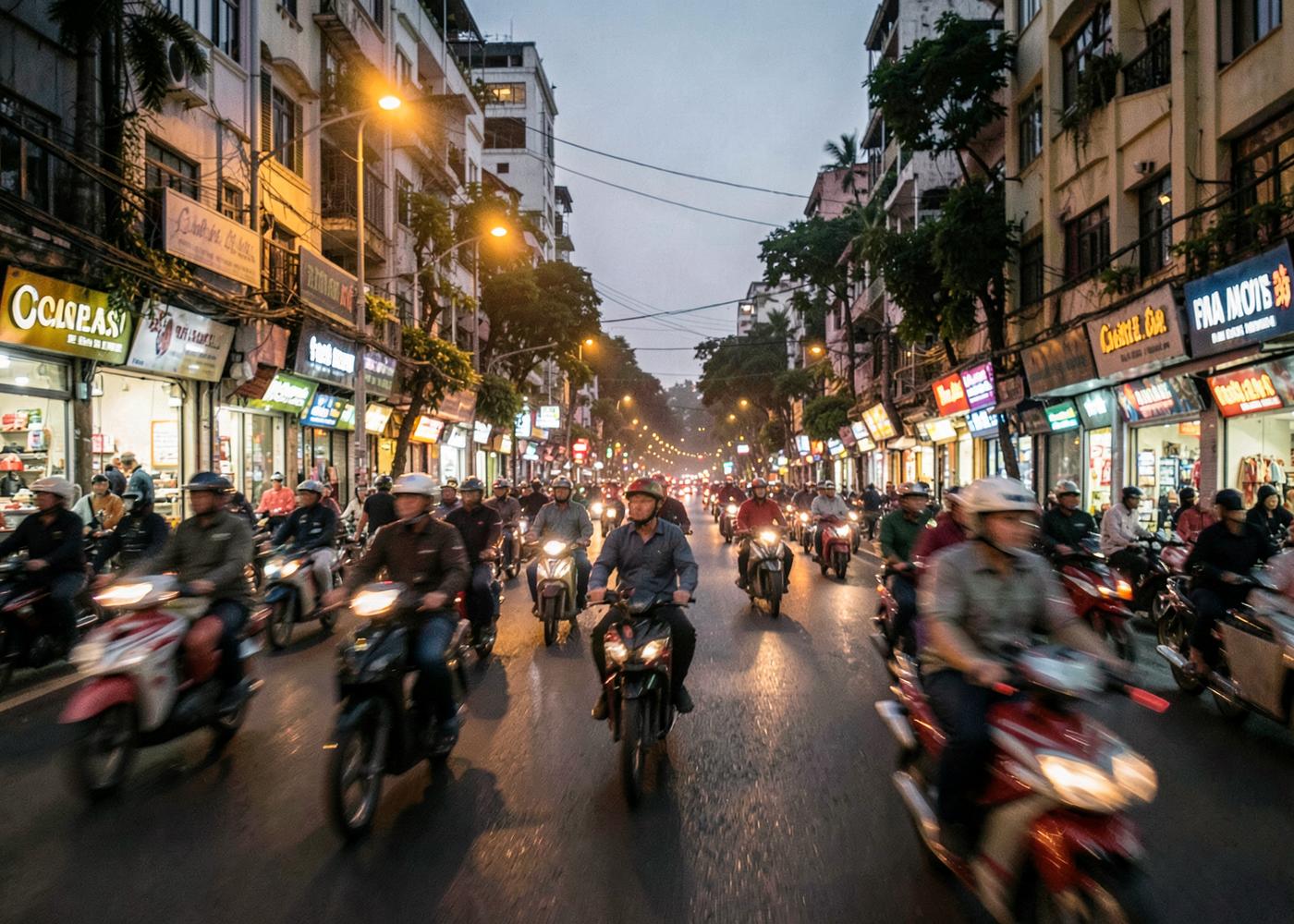
Most people have the same first reaction to Vietnam, and it is some version of "this is a lot".
The traffic is a lot. The noise is a lot. The pace of construction, the density of signage, the number of things happening simultaneously on any given stretch of pavement — all a lot. The natural response is to brace, plan carefully, and try to stay ahead of it.
That never works. What works is the opposite: stop treating the chaos as a problem to be managed and start treating it as the medium you are moving through. Vietnam gets dramatically easier and better at the exact moment you give that up.
The traffic is the first lesson and the best one
Crossing a road in Hanoi or Ho Chi Minh City teaches the entire national method in about ninety seconds. There is no gap. You walk out anyway, steadily, and several thousand kilograms of motorbike rearranges itself around you.
It is unnerving exactly once. Then it becomes obvious, and slightly enjoyable.
The rules, which are non-negotiable:
- **Move at a constant speed.** Predictability is the whole safety system.
- **Never run, stop, or step backwards.** Every rider has already calculated a path assuming you will not.
- **Look at the traffic further out**, not the bike about to pass your knee.
- **Tuck in behind a local** for the first few attempts. No shame in it.
Once that clicks, the rest of the country's apparent disorder reads differently. It is not disorder. It is a very high-throughput system with informal rules that everyone knows.
Sit on the small stools
Vietnamese social life happens at knee height on the pavement, on plastic stools around low tables, facing outward toward the street.
This is not a quirk for tourists. It is how the country eats and drinks. The stools are where phở gets served at six in the morning, where iced coffee gets nursed for an hour, where beer gets poured over ice in the evening and the day gets discussed.
Sitting on them is the single best decision a visitor can make. You get the best food, the lowest prices, and a front-row seat to the street, which is where everything interesting is happening anyway.
The whole country makes sense from a twenty-centimetre-high stool with a coffee, facing the road.
Coffee deserves your mornings
Vietnam is the second largest coffee producer on earth and the domestic culture around it is one of the best things in Southeast Asia.
The standard is cà phê sữa đá: dark robusta dripped through a small metal phin filter onto condensed milk, then poured over ice. It is strong, sweet, and cold, which is precisely the right combination in this climate.
Beyond that: egg coffee in Hanoi, whipped yolk over black coffee, closer to a dessert; coconut coffee, blended and slushy; and plain black with a little ice for anyone wanting the unmediated robusta experience.
The point is not the novelty. It is that coffee here is a reason to stop, sit and watch for an hour, which is the correct pace for a country this busy.
The food changes as you move
Vietnam is fifteen hundred kilometres of coastline and the food is genuinely regional, which is a good argument for moving around.
- **The north** is subtler and less sweet, with more black pepper and fewer chillies. Hanoi phở is clear and restrained. Bún chả — grilled pork in a dipping broth — is the city's other great lunch.
- **The centre**, around Hue and Hoi An, is the most complex. Hue's imperial kitchen tradition produces small, intricate dishes; bún bò Huế is the best noodle soup in the country and rarely gets the international attention phở does.
- **The south** is sweeter and more herb-heavy, influenced by the delta's abundance. Broken rice, grilled pork, cold noodle bowls, and fruit everywhere.
Bánh mì is national and regional at once — the fillings shift as you travel, and the argument about which city does it best is unwinnable and fun.
Distance is the planning problem
The country's shape is the main logistical constraint. Hanoi to Ho Chi Minh City is roughly two hours by air and thirty-plus hours by train.
Options, honestly assessed:
- **Domestic flights** are cheap and frequent, and are the sensible way to cover the long north-south hops.
- **The Reunification Express** is slow and the best scenery in the country, particularly the Hue–Da Nang coastal section over the Hai Van Pass. Do that leg specifically; the whole route is a commitment.
- **Sleeper buses** are cheap, fully reclining, and a distinctive experience that not everyone enjoys twice.
- **Motorbikes** for long-distance touring are a genuine tradition here and a genuine risk. Licences, insurance and experience all matter more than the rental shop will suggest.
Two weeks realistically covers two regions well or three regions in a hurry. Pick two.
Weather is regional, not national
There is no single season for Vietnam, because the north has a cool winter and the south does not have winter at all.
- **North:** cold and damp December to February, hot and wet in summer, best in spring and autumn.
- **Centre:** a distinct rainy and typhoon season around September to November.
- **South:** consistently hot, with a wet season roughly May to November that means a hard afternoon downpour rather than a lost day.
Any month is a good month somewhere. No month is good everywhere.
What changes around day four
The shift is reliable enough to predict. Somewhere around the third or fourth day, the horns stop registering. You cross without calculating. You have a stool and a coffee order. You start noticing detail instead of volume — the way pavement kitchens are organised, how nothing gets wasted, how much of daily life is conducted in public and in good humour.
Vietnam rewards that adjustment more than almost anywhere. It is an intense, fast, young, loud country that is also remarkably easy once you have stopped trying to hold it at arm's length.
Let it move around you. That is the whole technique, and it works on the traffic and everything else.
A first-timer's fortnight, honestly
**Days 1–4, Hanoi and around.** The old quarter on foot, egg coffee, bún chả, and either Ha Long Bay or the quieter karst landscapes inland at Ninh Binh. **Days 5–8, the centre.** Fly or train to Hue and Da Nang, take the coastal rail leg over the Hai Van Pass, and spend two nights in Hoi An. **Days 9–14, the south.** Ho Chi Minh City for the food, coffee and history, with a couple of nights in the Mekong Delta or on the coast.
Two regions done properly beats three done at speed. That is true everywhere and especially here.
Small things that make a difference
Check the digit count on banknotes before handing them over. Use ride-hailing rather than negotiating. Book the scenic train leg ahead in high season, because the good side of the carriage fills first. And build in one unplanned day per week — the thing you end up doing with it is usually the part you talk about afterwards.