
Laos · Story
Why Laos Feels Different
A quieter pace, bigger landscapes, and fewer reasons to rush
16 September 2026
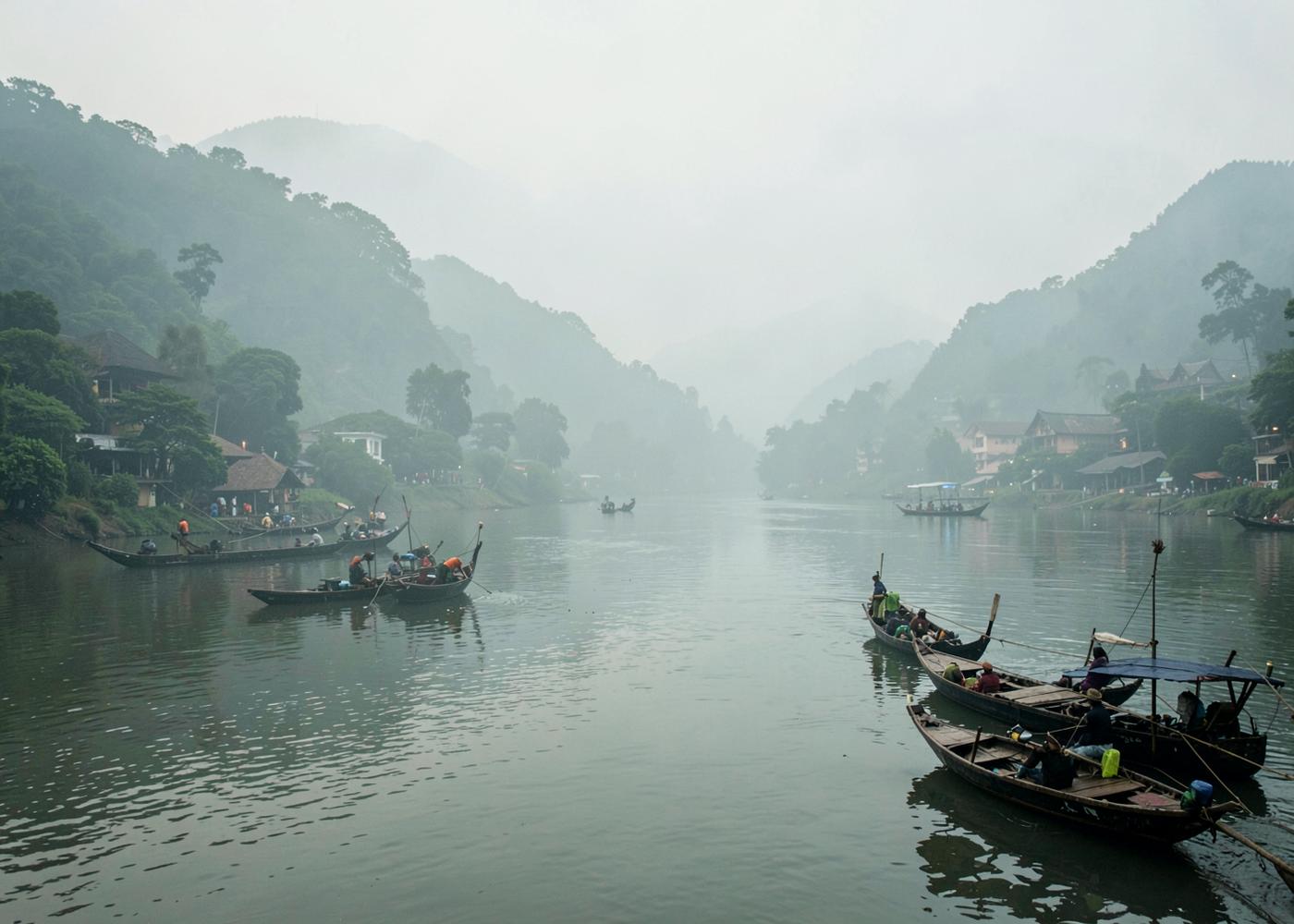
Laos is the country people add to the end of an itinerary and then wish they had given more time to.
It is landlocked, thinly populated, mountainous, and has fewer famous sights than its neighbours. What it has instead is space — a genuine sense that you have arrived somewhere that is not organised around visitors, and that the day is not going to be busy unless you make it busy.
That is the whole appeal, and it is harder to find in Southeast Asia every year.
Fewer people, and you feel it immediately
Around seven and a half million people live in Laos, in a country roughly the size of the United Kingdom, much of it mountain and forest. Thailand next door has close to ten times the population.
The effect at ground level is constant. Roads with no traffic. Towns where the main street is the only street. Riverbanks with one boat on them. Even Vientiane, the capital, feels like a large provincial town rather than a Southeast Asian capital — you can cross the centre on foot in twenty minutes and the loudest thing on most streets is a scooter.
For anyone arriving from Bangkok or Ho Chi Minh City, the first day in Laos is almost disorienting. The noise floor drops by half.
The landscape does the heavy lifting
Northern Laos is karst country — limestone peaks, river valleys, morning cloud sitting in the gaps between hills. Vang Vieng, which spent years known for something entirely different, has quietly become one of the better landscape destinations in the region: hot-air balloons over the karsts at sunrise, caves, lagoons, and a river running through the middle of it.
The Mekong is the other defining feature. It runs the length of the country and still functions as infrastructure, not scenery. The two-day slow boat from the Thai border to Luang Prabang is one of the great regional journeys — genuinely slow, occasionally uncomfortable, and an unbroken view of riverbank villages and forest for two days.
In the south, the Bolaven Plateau grows coffee at altitude and is cooler than everywhere else, and Si Phan Don — Four Thousand Islands — is where the Mekong spreads out into a braided delta of sandbars and channels, and where the recommended activity is a hammock.
Laos is the only country in the region where doing very little feels like the intended use rather than a wasted day.
Getting around changed recently
For years the honest answer about Laos was that distances were short on the map and long in reality: mountain roads, slow buses, eight hours to cover a hundred and fifty kilometres.
The railway changed the arithmetic. The high-speed line running from the Chinese border through Luang Prabang and Vang Vieng to Vientiane turned multi-day overland journeys into a few hours. It has made a two-week trip cover far more of the country than it used to.
The rest of the network remains as it was:
- **Minivans** connect most towns. They leave when full and are cramped.
- **Local buses** are slower, cheaper and more interesting.
- **Domestic flights** are limited but exist between the main centres.
- **Boats** still matter, especially in the north and the far south.
- **Motorbike loops**, particularly the Thakhek loop in the centre, are a genuinely great multi-day option for confident riders.
Food is distinct from Thai food, and worth attention
The overlap with northeastern Thailand is real — shared history, shared language roots, shared ingredients — but Lao cooking has its own logic: sticky rice as the staple at almost every meal, raw herbs eaten by the handful, and a comfort with bitterness that most regional cuisines avoid.
- **Laap**, minced meat with herbs, lime, chilli and toasted rice powder. The national dish.
- **Tam mak hoong**, the Lao papaya salad, hotter and funkier than the Thai version.
- **Khao piak sen**, a soft rice-noodle soup, the local breakfast.
- **Sticky rice**, eaten with your hands, rolled into a ball, used as a utensil.
- **Baguettes and pâté** from French-era bakeries, which have become entirely Lao in execution.
- **Bolaven coffee**, strong, sweet, and grown a few hundred kilometres away.
Practical notes
- **Cash is still king.** The kip is the currency, ATMs are present in towns and absent between them, and card acceptance is limited outside tourist businesses.
- **Best months are October to April.** February to April can bring heavy agricultural burning haze, which affects both air quality and the views.
- **It is conservative and religious.** Cover shoulders and knees at temples; the standard is noticed and appreciated.
- **UXO is a real issue** in parts of the country. Stay on marked paths in rural areas. This is not alarmism; it is standard local advice.
- **Nothing runs late.** Kitchens close early, towns go quiet, and the day starts before six. Adjust rather than fight it.
Where the pace actually gets you
The usual travel instinct — see more, move faster, compress the itinerary — works against you here. Laos does not have a long list of headline attractions, so a trip built around ticking them off finishes in four days and feels thin.
A trip built around spending time works much better. Three nights in one small town. A boat because it is a boat, not because of where it ends. A morning that is just coffee and a river.
That is a different kind of travelling, and not everyone enjoys it. The people who do tend to describe Laos as their favourite country in the region, and are usually slightly reluctant to explain why in too much detail.
Give it more days than you planned. That is the only real advice.
A rough two-week shape
- **Days 1–3, Luang Prabang.** Early mornings, the fresh market, Kuang Si Falls, and a boat on the Mekong.
- **Days 4–6, Vang Vieng.** Karsts, caves, lagoons, and a sunrise that is worth the alarm.
- **Days 7–8, Vientiane.** A capital that behaves like a provincial town, with good French-influenced food and a riverfront that fills up at dusk.
- **Days 9–14, the south.** The Bolaven Plateau for coffee and cooler air, then Si Phan Don for the part of the trip where the plan is a hammock.
The train makes the northern half of that trivial. The southern half is still buses and time, which is part of the character.
Small things that make a difference
Carry small notes; change is a constant negotiation. Start early, because the towns do and the heat does too. Learn "sabaidee" and use it liberally. Accept that the kitchen closes when the kitchen closes.
And leave one stretch of the itinerary undefined. Laos is the country most likely to make you cancel the next booking and stay where you are, and the trip is better if you have room to do that.